


The Electric Freightway, the UK’s first-ever public charging network dedicated to electric Heavy Goods Vehicles (eHGVs), is here. Launched by GRIDSERVE with the support of ZEHID and Innovate UK, the Electric Freightway programme will deliver high-power eHGV charging infrastructure at seven locations along the UK’s busiest motorways.
Is this the breakthrough we’ve been waiting on for net zero transport in the UK?
The transport emissions problem
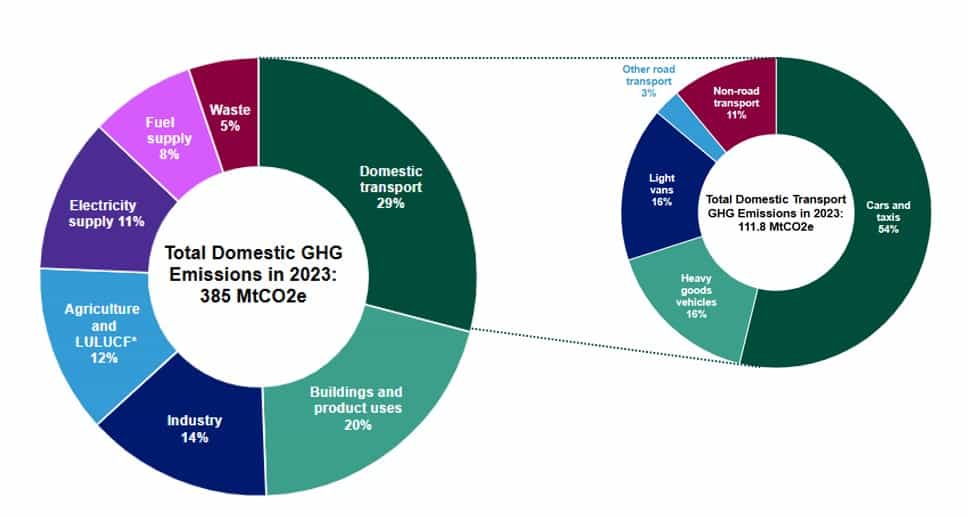
The answer depends, as many green transition answers do, on emerging technologies and how they mature together with government policy, private investment, and public enthusiasm. Whatever green technologies succeed, the need for a breakthrough could not be more urgent. Transport emissions make up 29% of total UK GHG emissions, making it the largest single source of CO2e, with HGVs contributing approximately 16%.
Driving change: the ZEHID programme
The Zero Emission HGV and Infrastructure Demonstrator (ZEHID) programme is a £200 million Department for Transport (DfT) funded initiative to explore the decarbonisation of road freight using battery electric vehicle (BEV) and hydrogen fuel cell (HFC) technologies. The programme sets out to guide future technology investment by running large-scale, real-world trials, deploying hundreds of zero-emission HGVs and over 70 infrastructure installations, and collecting critical operational data to inform long-term decision-making on the optimal technology mix.
eHGVs
According to the latest UK government statistics, there are nearly 90,000 EV charging points in the UK, a more than three-fold increase over the last four years. With an estimated 1.8 million licensed zero emissions vehicles now on the road in the UK, growing at 30 to 40% per year, the public has clearly embraced electrification as the solution to decarbonising passenger vehicles, and there is undeniable momentum for a similar switch to eHGVs . The Electric Freightway and other ZEHID trials are well positioned to overcome infrastructure hurdles such as requirements for megawatt charging speeds and renewable energy sourcing, giving hauliers the confidence to transition their fleets.
One stubborn problem with eHGVs remains: their weight. Gross vehicle weight (GVW) limits are imposed on all HGVs to mitigate the wear and tear on roads and bridges they cause. To stay within these GVW limits, eHGV operators must compromise payload capacity to accommodate heavy battery packs. Regulations introduced in 2023 sought to resolve this issue by increasing GVW by two tonnes to offset battery weight in eHGVs. But many in the haulage industry insist more refinement to the legislation is needed for the full benefit of the eHGV transition to be realised.
Hydrogen
ZEHID-funded hydrogen initiatives include the HyHAUL refuelling infrastructure project along the M4 in South Wales and England and the ZENFreight battery electric and hydrogen fuel cell HGV fleet demonstration and benchmarking project. While hydrogen itself has great potential as a zero carbon fuel source, the vast majority of commercially available hydrogen today is grey hydrogen, a fossil fuel product derived from natural gas. So-called blue hydrogen comes from the same fossil sources, with similarly limited climate benefits. Storing hydrogen also presents safety challenges. It is highly flammable and explosive, leaks are difficult to detect, and it must be stored under extreme pressure or temperatures, adding risk and complexity to handling.
Biofuels
The race to replace fossil fuels more broadly in transport has three main contenders: electrification, hydrogen, and biofuels. Though biodiesel and biomethane-powered HGVs are mature technologies in use today, biofuels have been notably absent from the ZEHID trials. This omission is likely driven by concerns over land-use changes and other environmental impacts required to scale up production. And the scale could be considerable indeed. As a Royal Society report on aviation biofuels concluded: “the amount of land needed to replace all the UK’s aviation fuel is over 50% of that available in the UK for agriculture.” But as the biofuels industry innovates and focuses more on waste and non-crop feedstocks, perhaps the story of biofuels in transport is not over.
The launch of the Electric Freightway and other ZEHID projects marks the end of theoretical debate and the start of demonstrating results in green logistics. Policymakers, investors, and industry players will be watching closely as data rolls in on the performance of a new generation of HGVs and infrastructure innovations.
We may soon see UK freight heading down a completely different lane.


