


Shifting baseline syndrome quietly reshapes how each generation understands the natural world. Without realising it, people accept a depleted environment as normal, which makes it harder to see what has been lost over time.
What shifting baselines mean
Shifting baseline syndrome describes the way each generation takes the state of nature they grew up with as “normal”, even if it is already heavily degraded compared with the past. Over time, those reference points keep lessening, so memories, expectations and even conservation targets are calibrated against a world that is already diminished. This can lead to a kind of “environmental generational amnesia”, where the abundance of wildlife, clarity of rivers, or thickness of ancient woods that once existed simply falls out of living memory.
Why loss becomes invisible
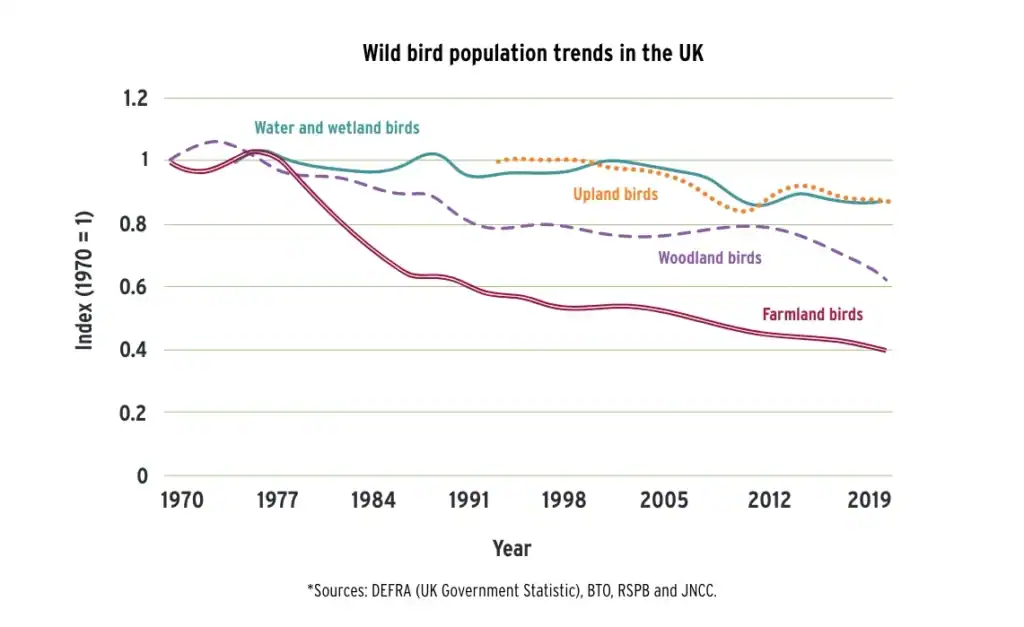
Because people judge change against their own childhood memories, they often underestimate the true scale of nature loss. If someone has never heard a dawn chorus thick with skylarks and warblers, they will not miss its absence, and may even think a thin, scattered birdsong is healthy.
This shrinking sense of what is “normal” means communities can become strangely complacent about degradation, arguing that things are “about the same as they’ve always been” when long-term data and older testimony tell a very different story.
Folk songs as ecological memory
Older folk songs can act as a cultural antidote to shifting baseline syndrome. Traditional lyrics are full of rivers rich with salmon, hedgerows bursting with birds, and meadows woven with wildflowers, offering glimpses of landscapes that were once taken for granted. When those songs are sung today, they quietly reveal how much has changed: the birds that no longer arrive, the fish that no longer run, the commons that have been fenced, drained or paved. In this way, folk traditions become a living archive of past ecologies, reminding listeners that the thin, quiet version of nature they know is not the only possibility.
Examples of shifting baselines in nature
One clear example is the “silent spring” morning. Older people remember country lanes where windscreens were splattered with insects after a short drive, and spring dawns when birdsong was almost deafening. Younger generations grow up with far fewer insects and a thinner chorus, yet may see this as perfectly normal. Another example is rivers that no longer sparkle. Children once swam in clear local rivers, caught minnows in jars, and knew stretches thick with trout or salmon, whereas today a murky, constrained channel is often accepted as a proper river. A third example is thinned-out forests and hedgerows, where seemingly “green” countryside – overgrazed hills, monocrops spanning hectares of fields, and narrow species-poor field margins mask the loss of dense hedgerows, old-growth trees and the rich communities of plants, insects and birds they once hosted.
What we can each do
There are practical ways for individuals to resist shifting baseline syndrome and help rebuild a sense of what healthy nature looks and feels like. One of the most powerful is to rebuild personal ecological memory by talking to older residents about how local rivers, woods and coastlines used to be, looking at archive photos, and reading older nature writing that describes past abundance. Keeping a simple nature diary, revisiting the same local spot through the seasons, and taking part in citizen science projects all sharpen perception and make the slow decline harder to ignore. Engaging with culture, whether folk songs, stories or community events that celebrate local species and seasons, also creates emotional anchors, turning abstract loss into something felt and therefore harder to accept.
When baselines shift back
Encouragingly, there are examples of expectations being reset upwards. In many cities, once-filthy rivers have been cleaned up through public pressure, regulation and restoration. As fish, kingfishers and even otters return, residents quickly adopt a new sense of what a city river should be like. Rewilded estates and farms show how rapidly birds, insects and wildflowers can rebound when natural processes are restored, giving visitors a richer mental image of what “normal countryside” might be.
Even small urban green spaces that swap close-mown lawns for wildflower meadows, ponds and scrub can rapidly transform local soundscapes and sightings, making flat, silent grass feel oddly empty. Each of these stories demonstrates that shifting baseline syndrome is not just a trap; with attention, memory and collective action, it can also be reversed, allowing us to understand and protect the nature around us.


